Designing for the Desert: Why T3-Rated Inverter & VRS Systems Are Essential for Extreme Gulf Climates
Oct 15 2026
Key Highlights
- Standard T1 air conditioners can struggle in Bahrain’s extreme summer temperatures, while T3-rated systems are built for higher ambient heat.
- T3 tropical climate AC systems use larger condenser coils, heavy-duty compressors and high-temperature components for reliable Gulf cooling.
- VRS systems in Bahrain reduce rooftop clutter while providing independent temperature control across multiple rooms and zones.
- An Awal Gulf VRS system offers longer piping runs, quieter operation and greater flexibility for modern building designs.
- Golden Fin coil protection, galvanized cabinets and dust-resistant electronics help HVAC systems withstand dust, sand and coastal salt.
- Local manufacturing, environmental testing and factory support make an Awal Gulf VRS system suited to Bahrain’s demanding climate.
Why Standard Air Conditioning Fails
When ambient air hits 48°C or 50°C, standard condenser coils cannot shed heat fast enough. Head pressure spikes. The compressor draws excessive amperage trying to keep up, runs scorching hot, and either trips out on high-pressure safety or burns out its motor windings within three or four years. It is a costly breakdown cycle that building owners across the region know.
Why a T3 Tropical Climate AC Is Essential
International HVAC standards divide cooling machinery into climate categories, namely: T1 for moderate climates and T3 for tropical and desert zones. The difference between them comes down to how the internal refrigeration circuits are engineered.
The T1 Rating: Designed for Mild Summers
Most air conditioners sold globally carry a T1 rating. They are designed for places where a hot summer day rarely exceeds 35°C. In laboratory tests, T1 units are rated strictly at 35°C ambient, and their safety controls shut them down if outside air creeps past 43°C.
The T3 Rating: Desert-Tested Engineering
A certified T3 tropical climate AC is completely different. Under ISO and GCC testing standards, its nominal cooling capacity has to be verified at 46°C, not 35°C. More importantly, the system is engineered to keep running continuously at 52°C and survive peaks of 55°C without cutting out.
To keep cooling under that kind of heat, manufacturers upgrade several core components including, attaching:
- Oversized condenser coils
- Heavy-duty tropical compressors
- High-temperature synthetic lubricants
- High-static condenser fans
Specifying a certified T3 tropical climate AC is the only way to ensure your air conditioning actually works on the hottest afternoon.
Variable Refrigerant Systems (VRS): Redefining Climate Control for Bahrain’s Architecture
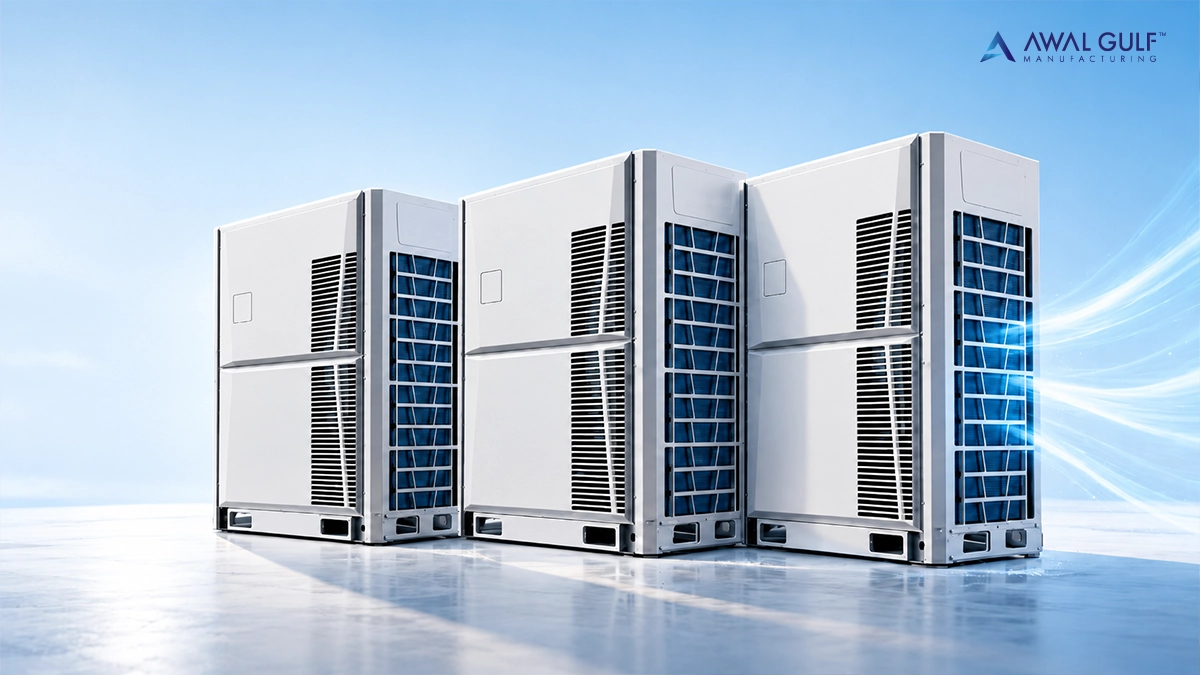
Traditional residential setups place a noisy outdoor condensing unit on the roof or wall for every single indoor split unit. A Variable Refrigerant System (VRS) changes that entirely. It links dozens of independently controlled indoor units back to one modular outdoor condenser using a shared refrigerant piping network.
For MEP consultants, architects, and homeowners in the Kingdom, VRS systems in Bahrain solve several persistent design and operational issues such as:
Eliminating Rooftop Clutter and Preserving Aesthetics
A large villa in Bahrain can easily need 12 to 16 indoor cooling units. If you go with standard mini-splits, that means 12 to 16 condenser boxes cluttering the roof, buzzing with vibration, and creating a blast of hot exhaust across your terrace.
Switching to an Awal Gulf VRS system consolidates that entire mechanical footprint into one or two modular outdoor frames. You get your rooftop back for roof gardens, or solar panels. Plus, you make far fewer penetrations through the roof slab, significantly lowering the risk of water leaks later on.
Zonal Comfort and Energy Independence
With an Awal Gulf VRS system, every indoor evaporator has its own electronic expansion valve (EEV) and thermostat. The system sends refrigerant only where cooling is actively requested.
Quiet Indoor and Outdoor Operation
Because the heavy compressor work happens far away on a service parapet or ground pad, indoor living areas stay quiet.
Longer Piping Runs Give Architects Real Flexibility
Modern VRS systems in Bahrain don’t have short limits. Total piping networks can span hundreds of meters, and the vertical height gap between the outdoor condenser and indoor evaporators can reach anywhere from 50 to 90 meters. That means engineers can place the outdoor units completely out of sight, behind a parapet or in a ground-level service yard without losing cooling power on the lower floors.
Built to Resist Dust, Sand, and Coastal Salt
Smart inverter controls won’t save an AC system if salt air rots the condenser coils after three summers. The Gulf’s coastal air is notoriously aggressive, and equipment needs real physical protection such as:
- Golden Fin Coil Protection
- Electro-Galvanized Steel Cabinets
- Dust-Proof Electronics with Refrigerant Cooling
Why the Awal Gulf VRS System Leads the Regional Market
Awal Gulf Manufacturing has been engineering air conditioning and commercial refrigeration in Bahrain for more than 50 years. That local heritage gives them a clear edge over imported units designed for milder overseas markets.
Here is why local developers and homeowners choose an Awal Gulf VRS system:
- Built for Real Gulf Heat: Every unit is developed specifically to handle sustained 50°C+ operating conditions without derating or tripping.
- Dedicated Environmental Testing Labs: Awal Gulf tests its machinery in specialized psychrometric chambers that simulate conditions from -20°C all the way to +60°C and 10% to 90% relative humidity.
- Direct Factory Engineering Support: Their local technical team collaborates directly on site with MEP consultants, contractors, and building owners to size and balance systems properly.
- No Waiting on Foreign Spare Parts: Because manufacturing happens right here in Bahrain, replacement parts, compressors, and certified factory technicians are available immediately.
- Trusted Internationally: Over 85% of what Awal Gulf manufactures is exported to more than 40 countries across the GCC, Africa, and beyond.
When you invest in Awal Gulf, you get five decades of homegrown engineering and direct factory backing right in your backyard.
Ready to upgrade your property’s climate control? Speak directly with the HVAC engineers at Awal Gulf Manufacturing to specify an Awal Gulf VRS system designed for your building.
Frequently Asked Questions
What is the practical difference between a T1 and T3 rated air conditioner in Bahrain?
T1 units are tested at 35°C and struggle once outside air gets above 43°C, often tripping breakers or blowing lukewarm air. A genuine T3 tropical climate AC is rated at 46°C and engineered to run continuously in ambient temperatures up to 52°C–55°C without compressor overload.
How does an Awal Gulf VRS system cut down power consumption?
The Awal Gulf VRS system uses DC inverter compressors and individual electronic expansion valves (EEVs) to modulate refrigerant flow to each room based on real-time demand.
How should you maintain a VRS system in Bahrain to stop coastal corrosion?
Start by selecting outdoor units with factory-treated coils and powder-coated galvanized casings. For routine upkeep, wash the condenser coils every few months with low-pressure fresh water to rinse off dried sea salt and dust.